the first Great Brain
Last and First MenThe first Great Brain is the first true individual of the Fourth Men, an artificial being designed to make research the center of an enlarged, carefully regulated life. His astonishing curiosity and lack of instinctive sympathy shape both his scientific work and his rule: he becomes an autocrat not through ordinary force alone, but through the combination of superior intelligence and the reverence of the people he governs. After millennia as a unique individual, he creates a distributed population of his kind to pursue research on a scale no single mind could manage.
Creation and Unusual Development
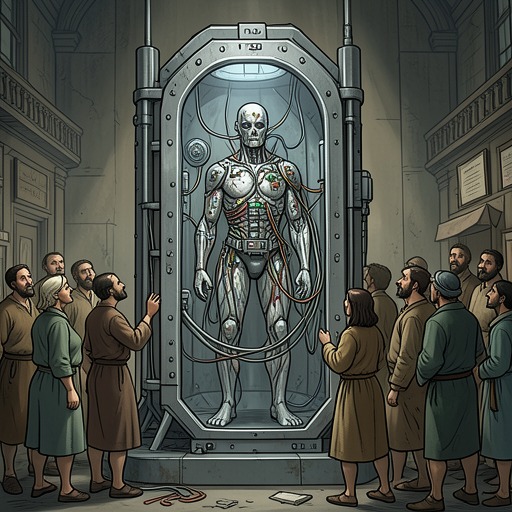
The first Great Brain was produced by artificial means, following the general plan used for earlier experimental beings but with more efficient mechanical and chemical systems. His makers adjusted the processes of growth and decay in the hope that he would be immortal; the text records their expectation, not whether it was fulfilled. The decisive alteration was architectural. Rather than allowing the brain to grow as ordinary hemispheres, his makers directed its cells into compartments prepared within a large circular brain-turret. The resulting structure, built of ferro-concrete, was about forty feet in diameter, with passages leading from a central space between tiers of cupboards. Tubes carried blood and chemicals through the system, while electric radiators maintained warmth and gauges and indicators let attendants monitor its physical changes.
His intellectual growth was extraordinary in duration as well as outcome. Eight years after the organism began, its brain room was full and it had reached the mentality of a newborn infant. It did not attain the mental level of a bright adolescent until nearly the end of its fifth decade. Yet within another decade it had learned everything the Third Men could teach it—and recognized that much of their wisdom was folly. Slow maturation thus gave way to rapid intellectual independence: the educated specialists who had been assembled to answer its questions and assist its experiments found themselves reduced to clerical and practical service, while its curiosity ranged beyond their comprehension.
Research and Temperament
Curiosity is the first Great Brain’s dominant characteristic, joined by constructiveness and exceptional manual dexterity. Manipulation gives him intense pleasure, but he uses his hands chiefly in the service of investigation. His servants continually travel across the planet to obtain information and specimens; even they often do not understand the significance of the missions they carry out. The state’s learned attendants, once prepared to instruct him, become assistants to inquiries whose direction and meaning belong to him alone.
His mind lacks nearly every ordinary instinctive response. He does not experience instinctive fear, anger, hunger, thirst, sex, tenderness, or group feeling. This does not make him careless: when his body or research is threatened, he can exercise cold caution, and opposition meets adamantine firmness. Inadequate nourishment produces faintness rather than ordinary hunger or thirst. Nor does intimate service awaken gratitude in him; the devotion of his closest attendants wins only cold approval. The distinction is central to his character: he can understand and manage other people’s emotions without sharing them.
Rule over the Third Men
At first, the first Great Brain takes no interest in the affairs of the society that maintains and adores him. His political influence develops when he begins proposing solutions to current problems of social organization. The advice is increasingly sought and accepted until he becomes autocrat of the state. His authority rests on an unusual conjunction: his superior intelligence and complete detachment are reinforced by the people’s superstitious reverence, making his position more secure than that of an ordinary tyrant.
He is not moved by the small troubles of the people, but insists that the race serving him remain harmonious, healthy, and potent. His study of human nature is a diversion from physics and astronomy, yet he builds an accurate behavioral psychology of the Third Men. Though their emotional life is foreign to him, he can judge what they are likely to do, much as a skilled trainer understands the limits of animals. He despises their admiration of animals and plants and their religion of life, but learns not to oppose these commitments openly; instead, he turns them to his own purposes.
That accommodation also serves his experiments. He regards animals as material for research and disregards the customary means of preventing pain. The Third Men assist him partly because he assures them that his work will improve every type of life, and partly because the suffering produced by his experiments fascinates them. Their response exposes a cruelty that had long been suppressed but remained strong beneath their apparent intuitive understanding of animal nature. The first Great Brain’s rule therefore depends not simply on his intelligence, but on his capacity to use the values of the people he governs—even when those values do not restrain the harm done in his laboratories.
Creating the Fourth Men
Some three thousand years after his own beginning, the first Great Brain decides to create others of his kind. The decision does not arise from loneliness, a desire for love, or a need for companionship. He wants collaborators of equal mental stature because more profound research requires more than one such intelligence. He orders improved turrets and factories built in different regions, and directs his servants to cultivate a cell from his vestigial body in each facility. At the same time, he undergoes extensive operations to remake himself on a more ample plan.
The new beings receive direct sensitivity to radiation through a specially bred strain of Martian parasites incorporated into their brain tissue. Each brain also has a powerful wireless transmitter, enabling the scattered population to maintain direct telepathic contact. The undertaking produces about ten thousand individuals, each specialized for a particular region and function. Some study the heavens from observatories on high mountains; others, adapted to heat, investigate subterranean forces. Across the tropics, the Arctic, forests, deserts, and ocean floor, the Fourth Men pursue their investigations, while a group of a hundred gathers in great buildings around the first Great Brain. His founding act converts solitary, instrument-bound curiosity into a planetary research system: the people created to extend his work remain distinct individuals, but their specialization and communication place their collective enterprise under the direction of its pioneer.